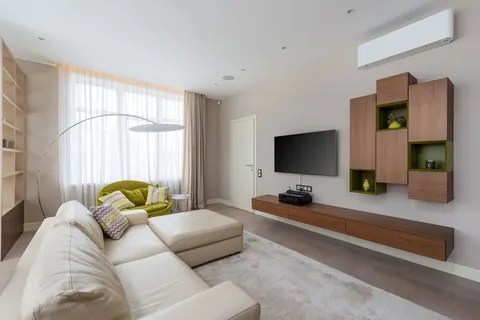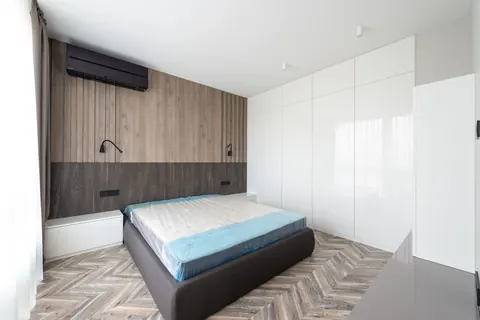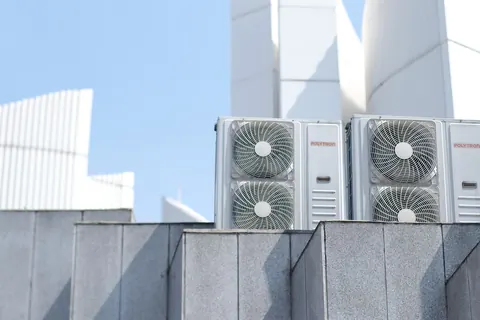

When most people picture a mini split, they see the white rectangular unit hanging on the wall. But wall mounts are just one of four distinct indoor unit types, and choosing the right one can dramatically affect comfort, aesthetics, and installation cost.
Each type has specific strengths, limitations, and ideal use cases. Let's compare them all.
1. Wall-Mounted Units
The most popular mini split indoor unit by far. Over 80% of residential installations use wall-mounted air handlers.
How They Work
The unit mounts high on an interior wall (typically 6–7 feet up), near the ceiling. Air is drawn in through the top, passes over the evaporator coil, and is blown out through adjustable front louvers. The lineset connects through a hole behind the unit or to the side, running down the wall and outside.
Advantages
- Lowest cost: Typically $200–$600 less than other styles (unit only)
- Easiest installation: Can be installed in 4–6 hours
- Best airflow for most rooms: High-mount position allows conditioned air to fall naturally
- Widest selection: Every brand and model line offers wall-mount options
- Easy maintenance: Filters are accessible from the front panel
Disadvantages
- Visible on the wall: Some homeowners find the aesthetic intrusive
- Not ideal for very large rooms: Airflow is directional; corners of large spaces may get less conditioning
- Requires suitable wall space: Needs a wall that can accommodate the unit without obstructions
Best For
Bedrooms, living rooms, home offices, garages, workshops, most standard residential rooms.
Typical Specs
- Sizes: 9,000–36,000 BTU
- Noise level: 19–40 dB
- Dimensions: 32"–42" wide × 11"–14" tall × 8"–10" deep
2. Ceiling Cassette Units
Ceiling cassettes are flush-mounted into a drop ceiling or framed opening, with only the decorative grille visible from below. They're the most discreet option and popular in commercial settings.
How They Work
The cassette body sits above the ceiling line. A decorative panel (usually square, 24" × 24" to match standard ceiling tiles) is the only visible element. Air is drawn up through a center intake and blown out through 1, 2, or 4 directional vanes around the perimeter.
Advantages
- Nearly invisible: Only the flat grille panel is visible, no wall-mounted box
- Superior air distribution: 4-way cassettes blow air in all directions, excellent for large open rooms
- No wall space needed: Ideal for rooms with windows on every wall or limited wall space
- Commercial aesthetics: Professional look for offices, retail spaces, and restaurants
- Quieter in some configurations: Sound is directed upward, away from occupants
Disadvantages
- More expensive: Units cost $300–$800 more than equivalent wall mounts
- Complex installation: Requires ceiling access (attic space or drop ceiling), ceiling reinforcement, and longer installation time (8–12 hours)
- Harder to service: Filter access requires reaching up or removing the panel
- Ceiling height requirements: Need at least 8–10 inches of clearance above the ceiling for the cassette body
- Condensate pump often required: Since the unit is above the ceiling, gravity drainage may not work. A pump adds $100–$200
Best For
Open-plan living areas, commercial spaces, restaurants, rooms with floor-to-ceiling windows, and any space where wall aesthetics are a priority.
Typical Specs
- Sizes: 9,000–48,000 BTU
- Noise level: 25–42 dB
- Panel dimensions: 24" × 24" or 33" × 33" (body above ceiling is larger)
3. Floor Console Units
Floor consoles sit at or near floor level, similar in appearance to a baseboard heater or slim radiator. They can be recessed into the wall or stand freely against it.
How They Work
Air enters through the front (low) and is blown upward and outward through the top vane. Some models have dual-discharge: blowing from both top and bottom for even room distribution.
Advantages
- Excellent for heating: Warm air is delivered at floor level where people feel it most, then rises naturally. Superior heating comfort compared to high-mount wall units.
- No high-wall mounting: Great for rooms with sloped ceilings, large windows, or structural limitations
- Easy filter access: Filters are at floor level, no reaching or climbing
- Lower installation height: The lineset hole is near the floor, which can be easier to route
- Ideal for elderly/accessibility: Controls and filters are reachable without a ladder
Disadvantages
- Takes up floor space: The unit protrudes 8–10 inches from the wall, which may interfere with furniture placement
- Less effective for cooling: Cold air from floor level doesn't distribute as well as from ceiling height, though auto-swing louvers help
- Fewer model options: Less variety compared to wall mounts
- Potentially more dust: Being at floor level means the unit may collect more dust and debris
Best For
Rooms with large windows (mount under the window), spaces with sloped or low ceilings, sunrooms, rooms prioritizing heating comfort, and accessible/universal design applications.
Typical Specs
- Sizes: 9,000–18,000 BTU
- Noise level: 22–38 dB
- Dimensions: 24"–30" wide × 24"–28" tall × 8"–10" deep
4. Concealed Duct (Slim Duct) Units
Concealed duct units are hidden entirely: mounted in a ceiling, attic, closet, or soffit. They deliver conditioned air through short duct runs and registers, just like a mini ducted system.
How They Work
The slim air handler sits above a ceiling or inside a closet. Short flexible ducts (typically 1–3 runs, each 6–15 feet) connect to supply registers in the ceiling or wall. A return air grille draws room air back to the unit. From the room, all you see are standard supply and return registers, no visible HVAC equipment at all.
Advantages
- Completely hidden: The only visible elements are standard ceiling/wall registers
- Multiple room distribution: One ducted unit can serve 2–3 adjacent rooms via separate duct runs
- Architectural flexibility: No restrictions on wall or ceiling placement
- Perfect for renovations: Looks like central air but with mini split efficiency
- Works with existing partial ductwork: Can connect to short duct sections in homes with limited existing ducts
Disadvantages
- Most expensive indoor unit type: $400–$1,000+ more than wall mounts, plus ductwork costs
- Longest installation time: 1–2 days including duct fabrication
- Requires ceiling/attic access: Need space above the ceiling for the unit and ducts
- Slight efficiency loss: The short ducts introduce some energy loss (though far less than a full central air duct system)
- Professional design required: Duct sizing, register placement, and static pressure calculations need professional planning
Best For
Luxury homes, renovations wanting a "no visible equipment" look, multi-room conditioning from one indoor unit, commercial spaces with aesthetic requirements, and historic homes where wall-mounted units would look inappropriate.
Typical Specs
- Sizes: 9,000–48,000 BTU
- Noise level: 24–40 dB
- Unit dimensions: Compact enough for ceiling cavities (8"–12" tall)
- Static pressure: 0.1–0.6 in. w.g. (determines duct run capability)
Comparison at a Glance
| Feature | Wall Mount | Ceiling Cassette | Floor Console | Concealed Duct |
|---|---|---|---|---|
| Visibility | Visible on wall | Grille in ceiling | Visible at floor | Registers only |
| Install cost | Lowest | Moderate-high | Low-moderate | Highest |
| Install time | 4–6 hours | 8–12 hours | 4–6 hours | 8–16 hours |
| Heating comfort | Good | Good | Excellent | Good |
| Cooling distribution | Good | Excellent | Fair | Good |
| Multi-room capability | No | No | No | Yes (2–3 rooms) |
| Maintenance ease | Easy | Moderate | Easy | Harder |
| Best for | Most rooms | Open plans, commercial | Under-window, heating | Hidden installs |
Mixing and Matching
One of the biggest advantages of multi-zone mini split systems is the ability to mix different indoor unit types on the same outdoor unit. A common configuration:
- Living room: Ceiling cassette for even distribution and clean aesthetics
- Bedrooms: Wall mounts for simplicity and quiet operation
- Kitchen: Concealed duct to keep the unit out of sight
- Sunroom: Floor console under the windows for superior heating
This flexibility is unique to ductless systems and lets you optimize each room individually.
The Bottom Line
There's no single "best" indoor unit type, only the best type for your specific room, budget, and aesthetic preferences. Wall mounts dominate for good reason (affordable, effective, easy to install), but the other three options solve real problems that wall mounts can't.
Talk to your installer about your specific rooms, and don't assume wall mount is the only option.